
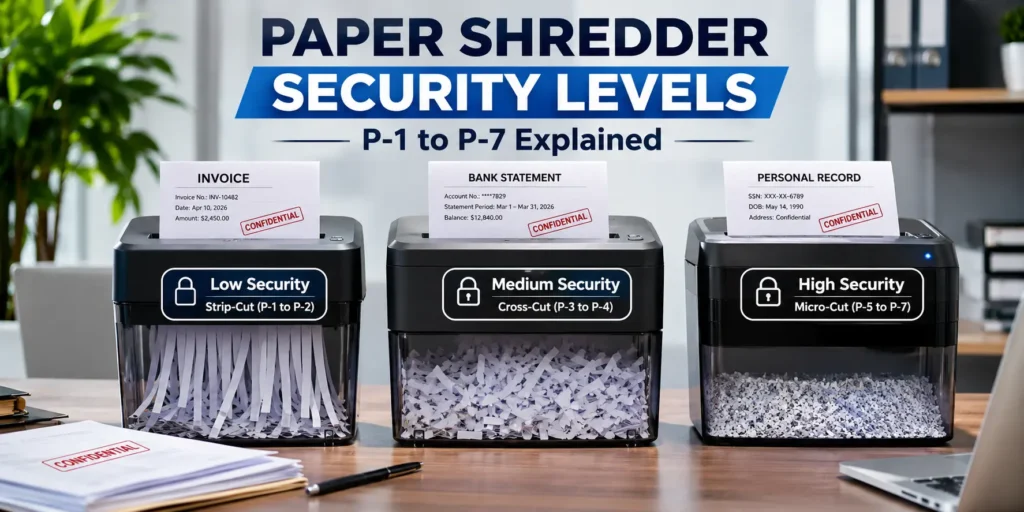
Two paper shredders can both carry a cross-cut label yet offer very different levels of protection. So, how do you know which one is safer?
That’s where paper shredder security levels come in. These ratings can look confusing, especially when you’re comparing different models. But choosing the right one doesn’t have to be difficult. This guide explains each security level in simple terms and helps you find the right shredder for your documents.
What Are Paper Shredder Security Levels?
Paper shredder security levels show how small a shredder cuts paper and how difficult it is to recover the information. The system ranges from P-1 (lowest security) to P-7 (highest security).
A P-1 shredder produces larger paper pieces, while a P-7 shredder cuts documents into tiny particles. Smaller pieces are much harder to put back together and read.
These ratings help you compare shredders and choose the right protection. For everyday papers, lower levels may work fine. Sensitive documents, however, need a higher security level.
Where Do Security Levels Come From?
Paper shredder security levels follow recognised standards for destroying sensitive information. These standards help manufacturers rate their shredders and give buyers a clear way to compare protection.
The DIN 66399 Standard
Introduced in 2012, DIN 66399 sets rules for secure data destruction. It replaced the older DIN 32757 standard, which offered fewer security levels. The updated system made it easier to classify different types of sensitive information.
ISO/IEC 21964
DIN 66399 is also known internationally as ISO/IEC 21964. This standard follows the same particle size limits, so the P-1 to P-7 ratings remain unchanged.
What the “P” Means
The letter “P” stands for paper and other original-size media, while different letters cover optical discs, hard drives, and magnetic tapes.
Paper Shredder Security Levels Chart (P-1 to P-7)
Paper shredders come with seven security levels, ranging from basic protection to highly secure document destruction. The main difference is the size of the paper pieces left after shredding.
The following chart shows the maximum particle sizes and what each level is generally used for.
| Level | Max Particle Size | Security Rating | Best For |
|---|---|---|---|
| P-1 | 2,000 mm² or 12 mm strip width | Very Low | Flyers, brochures, general waste |
| P-2 | 800 mm² or 6 mm strip width | Low | Non-confidential internal papers |
| P-3 | 320 mm² or 2 mm strip width | Basic | General business and personal papers |
| P-4 | 160 mm² | Medium-High | Bank statements, bills, and tax records |
| P-5 | 30 mm² | High | Medical records and confidential business files |
| P-6 | 10 mm² | Very High | Secret and highly sensitive documents |
| P-7 | 5 mm² | Maximum | Top-secret and classified information |
Levels P-1 and P-2 (Low Security)
P-1 and P-2 offer basic document protection. Both use strip-cut shredding, leaving long paper strips that can still be pieced together.
These levels work better for flyers, old brochures, and junk mail. Avoid using them for documents containing personal or financial information.
Level P-3 (Basic Security)
P-3 provides better protection than basic strip-cut shredders. It cuts paper into smaller particles, making document reconstruction more difficult.
It’s a reasonable choice for general internal papers and everyday documents without highly sensitive information.
Levels P-4 and P-5 (Medium to High Security)
P-4 and P-5 are popular choices for documents containing private information. They produce much smaller pieces, making it harder to recover the original content.
Use these levels for bank statements, tax papers, medical records, and confidential business files.
Levels P-6 and P-7 (Very High Security)
P-6 and P-7 offer the highest levels of paper destruction. They are designed for classified documents and highly secret information.
However, these shredders usually cost more and may process fewer sheets per minute. Most homes don’t need this level of protection.
Which Security Level Do You Need?
The right paper shredder depends on the type of documents you handle. You don’t always need the highest security level. It should simply offer enough protection for the information you’re destroying.
For Junk Mail and Everyday Papers
P-2 or P-3 is usually enough for flyers, brochures, old notes, and everyday paperwork. These levels offer basic protection without spending extra on a high-security shredder.
For Bank Statements, Bills, and Tax Papers
P-4 is a common choice for personal financial documents. It provides good protection for bank statements, bills, and tax papers. If you want extra protection, P-5 is worth considering.
For Medical or Business Records
P-4 or P-5 works well for medical records, customer details, and confidential business files. Check your industry’s data protection rules before choosing a shredder.
For Top-Secret Material
P-6 or P-7 is designed for highly sensitive and classified documents. Most homes don’t need this level unless they regularly handle extremely confidential information.
Final Thoughts
Choosing the right paper shredder security level depends on the type of documents you handle and how much protection they need. Higher security levels produce smaller paper pieces, making it harder for anyone to recover sensitive information.
For most homes and small businesses, P-4 or P-5 offers a good balance of security and everyday use. You don’t need the highest-rated shredder unless you regularly handle highly confidential documents.
Have a large pile of old paperwork to destroy? Check out our paper shredding events near you for a convenient way to dispose of unwanted documents safely.
Frequently Asked Questions
What is the most common security level for home shredders?
P-4 is one of the most common choices for home use. It offers good protection for personal and financial documents.
Is P-4 secure enough for personal documents?
Yes, P-4 is suitable for most personal documents, including bank statements, bills, and tax records. It cuts paper into small pieces that are difficult to reconstruct.
Is a P-7 shredder worth it for home use?
Usually not. P-7 is designed for highly classified information, so most households don’t need this level of protection.
Do higher security levels shred more slowly?
Generally, yes. Higher security shredders produce smaller particles and often process fewer sheets per minute. They may also require more frequent emptying.