
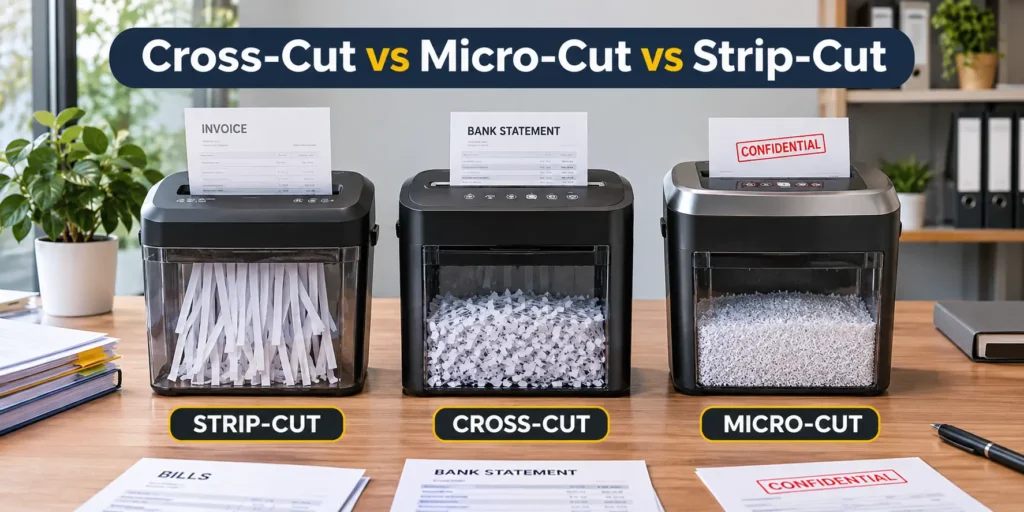
Not all paper shredders destroy documents in the same way. Some cut paper into long strips, while others turn it into tiny pieces. This difference matters, especially when you’re disposing of bills, bank statements, or personal records.
If you’re confused about cross-cut vs micro-cut vs strip-cut shredders, you’re not alone. Let’s look at how they differ, what each one offers, and which type makes the most sense for your needs.
Quick Comparison: Which Shredder Cut Is Best?
A strip-cut shredder is the cheapest and fastest option, but it offers the least security. Cross-cut shredders provide a good balance of price and protection, making them suitable for most homes. Micro-cut shredders cost more, but they offer the highest level of document security.
Here’s a quick comparison to help you understand the differences.
| Cut Type | Security Level | Speed | Price | Best For |
|---|---|---|---|---|
| Strip-Cut | Low | Fast | Low | Junk mail and flyers |
| Cross-Cut | Medium to High | Moderate | Medium | Everyday home documents |
| Micro-Cut | Very High | Slower | High | Sensitive and confidential papers |
The right choice depends on what you usually shred. If you only dispose of unwanted flyers, strip-cut may be enough. For bills and bank statements, cross-cut is a better option. Choose micro-cut when protecting personal or financial information matters most.
What Is a Strip-Cut Shredder?
A strip-cut shredder is the most basic type of paper shredder. It cuts documents into long, thin strips, almost like spaghetti. These strips are easy to produce, but they don’t offer much protection for sensitive information.
You will often find strip-cut shredders in offices where employees need to dispose of large amounts of unwanted paper. They are simple to use and usually cost less than other shredder types. However, they may not be the right choice when document security is a concern.
How Strip-Cut Shredder Works
A strip-cut shredder uses rotating blades to cut paper into narrow vertical strips. The blades move in one direction, so the machine doesn’t break the paper into smaller pieces.
As a result, the shredded strips can still contain readable words, numbers, and other details. This is the main reason strip-cut shredders offer limited document protection.
Pros of Strip-Cut Shredder
The biggest advantage of strip-cut shredders is their low price. They are usually cheaper than cross-cut and micro-cut models, making them a budget-friendly option.
They also shred paper quickly and often handle more sheets in one pass. This makes them useful when you have large piles of unwanted paperwork and don’t need a high level of security.
Cons of Strip-Cut Shredder
The biggest drawback is their low security. Since the machine only creates long strips, someone could collect them and piece the original document back together.
This may take some time, but it is still possible, especially when the document contains only a few lines of text. That’s why strip-cut shredders aren’t suitable for papers containing financial details or personal information.
Best For
A strip-cut shredder works well for junk mail, flyers, old notes, advertisements, and other papers without personal details. It’s a reasonable choice if you mainly want to reduce paper clutter.
However, avoid using it for bank statements, tax documents, bills, or confidential records. For those papers, a cross-cut or micro-cut shredder offers better protection.
What Is a Cross-Cut Shredder?
A cross-cut shredder offers better document protection than a basic strip-cut model. Instead of cutting paper into long strips, it cuts documents in two directions, creating small rectangular pieces. This makes it much harder to put the original document back together.
Cross-cut shredders are a popular choice for homes because they offer a good balance between security and price. They can handle everyday paperwork without costing as much as most micro-cut models. If you regularly dispose of bills or personal documents, this type is worth considering.
How Cross-Cut Shredder Works
A cross-cut shredder uses two sets of cutting blades to slice paper horizontally and vertically. The paper breaks into small, confetti-like rectangles instead of long strips.
Since the pieces are much smaller, reading or rebuilding the original document becomes difficult. The exact size depends on the shredder model and its security rating.
Pros of Cross-Cut Shredder
Cross-cut shredders provide good security at a reasonable price. They are more secure than strip-cut models and usually cost less than micro-cut alternatives.
They also work well for most household papers, including bills, receipts, and old letters. You don’t need to spend extra on a high-security machine for everyday shredding needs.
Cons of Cross-Cut Shredder
Cross-cut shredders are generally slower than strip-cut models. Their cutting mechanism also produces smaller paper pieces, which means the collection bin fills up faster.
Some models may also need more frequent emptying and occasional maintenance to keep the blades working smoothly.
Best For
A cross-cut shredder is a good choice for everyday home use. You can use it to destroy bills, bank statements, receipts, and other papers containing personal information.
Before shredding old bank statements, check how long you need to keep them. Once you no longer need those records, a cross-cut shredder can help dispose of them safely.
What Is a Micro-Cut Shredder?
A micro-cut shredder offers the highest level of document security among the three common shredder types. Instead of producing long strips or small rectangles, it cuts paper into tiny, confetti-like pieces. This makes it extremely difficult to read or put the original document back together.
Micro-cut shredders are often used by people who regularly handle sensitive paperwork. They cost more than strip-cut and cross-cut models, but the extra security can be worth it. If protecting personal or financial information is your main concern, this type is worth considering.
How Micro-Cut Shredder Works
A micro-cut shredder uses specially designed cutting blades to break paper into very small pieces. The machine cuts in multiple directions, leaving behind tiny particles instead of larger paper sections.
These pieces are much harder to arrange into their original form. The exact particle size depends on the model and its security rating.
Pros of Micro-Cut Shredder
The biggest advantage of a micro-cut shredder is its high security. It provides better protection than both strip-cut and cross-cut models, making it suitable for documents containing confidential information.
It also produces more compact paper waste. Since the shredded pieces take up less space, the collection bin can hold more shredded material before needing to be emptied.
Cons of Micro-Cut Shredder
Micro-cut shredders usually cost more than other types. They also have a lower sheet capacity, so you may need to feed fewer sheets at a time.
Another drawback is their slower shredding speed. Processing large piles of paper can take longer, especially with smaller home models.
Best For
A micro-cut shredder is a good choice for tax records, medical papers, financial documents, and paperwork containing an ID number. These documents often carry information that you wouldn’t want others to access.
Before destroying old tax records, check how long you need to keep them. Once they’re no longer required, a micro-cut shredder offers an extra layer of protection during disposal.
How to Choose the Right Cut Type for You
The best shredder depends on the type of documents you handle and how much security you need. You don’t always need the most expensive model. Think about what you shred regularly before making a choice.
For Light Home Use
If you mainly shred junk mail, flyers, and old notes, a strip-cut shredder may be enough. A basic cross-cut model is another option if you want a little more protection without spending much.
For Sensitive Personal Papers
For bills, bank statements, receipts, and documents with personal details, choose at least a cross-cut shredder. A micro-cut model is a better choice if you want extra protection against information theft.
For a Home Office
If you regularly handle client records, financial paperwork, or business documents, consider a micro-cut shredder. Look for a larger collection bin and longer run time, too. These features matter when you have several documents to destroy in one session. If you’re still comparing options, our guide on how to choose a home paper shredder can help you narrow down the right model.
Frequently Asked Questions
Is a cross-cut shredder secure enough for bank statements?
Yes, a cross-cut shredder provides enough security for most household bank statements. It cuts documents into small pieces, making it difficult to read or rebuild the original information.
Is a micro-cut shredder worth the extra cost?
Yes, if you regularly destroy sensitive documents. It offers better security and is useful for tax records, medical papers, and financial documents.
Can someone rebuild strip-cut shredded paper?
Yes, it is possible. Strip-cut shredders produce long strips that someone could collect and piece back together.
Do micro-cut shredders jam more often?
They can, especially when overloaded. Feeding fewer sheets at a time and following the manufacturer’s instructions can help prevent jams.